The popularity of China’s inbound tourism market continues to surge, with an increasing number of international travelers enjoying “China Travel.” A recent inbound tourism research report released by Trip.com Group shows that China is becoming one of the world’s top tourist destinations, with its tourism reception capacity, infrastructure development, and safety environment receiving widespread praise from foreign visitors.
More Convenient Travel
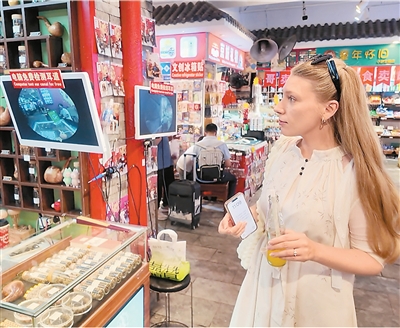
“The travel experience in China is excellent. The ample transit visa-free time allowed me to move freely between multiple scenic spots and shopping malls in Guangdong, greatly extending my travel itinerary. The ‘instant refund’ policy meant that after purchasing my favorite electronic products, I could collect the tax refund cash at the mall in just five minutes,” said Katy, a Russian tourist.
Foreign tourists are showing growing interest in traveling to China. From 2024 to the first quarter of 2025, the number of foreign visitors booking flights and hotels to enter China through Trip.com’s overseas platforms doubled year-on-year, while orders for local leisure products tripled. Trip.com’s overseas platforms have partnered with more than 10,000 domestic scenic spots to offer online ticketing services, and have installed nearly 900 international ticketing machines at 115 attractions, including Badaling Great Wall and the Mausoleum of Qin Shi Huang’s Terracotta Warriors, supporting multilingual interfaces and multiple international payment methods. In addition, the platforms have launched over 10,000 one-day and half-day tour products, such as a half-day tour of the Forbidden City, a one-day tour of Mutianyu Great Wall, and a trip to Yulong Snow Mountain in Lijiang, all of which are very popular among foreign tourists.
The research report indicates that foreign tourists hold a generally positive impression of traveling in China, mainly reflected in three aspects. First, hospitality and safety: multiple surveys and actual feedback from foreign visitors show that China’s hospitality ranks among the best in the world, especially earning praise from families and female travelers. Advanced technological applications and a highly secure social environment make them feel particularly at ease during their stays. Second, advanced infrastructure and convenient transportation: high-speed rail, subways, airports, and public sanitation facilities have all received widespread acclaim. Visitors from Japan, South Korea, Europe, and the United States have remarked that Chinese cities are clean, transportation is efficient, and the level of modernization is impressive. Third, digital tools enhance the experience: the payment and translation features of Alipay and WeChat, the one-stop services of Trip.com, and the smart services at scenic spots and restaurants have greatly alleviated language barriers and improved travel convenience.

Richer Experiences
Hotels are a key part of tourism services. According to managers of multiple hotels in Beijing, Guangzhou, Shenzhen, Chengdu, and other cities, the number of foreign guests has grown significantly since the beginning of this year, particularly from countries such as South Korea, Malaysia, Japan, Thailand, and Singapore. “In July, the proportion of inbound tourist orders at our hotel exceeded 50%,” said the general manager of a four-star hotel in Shanghai.
To provide better services for foreign guests, many hotels are enhancing their reception capacity and user experience through technological empowerment and service upgrades. “We receive multilingual booking inquiries every day. In the past, everything was handled manually, which was inefficient and costly. Now, we use technology to overcome language barriers,” admitted a hotel operator. After adopting the AI-powered multilingual customer service system on Trip.com’s merchant assistant, Shanghai Treasure Hotel reduced the average daily response time for foreign guest inquiries from half a day to just 30 minutes. In the first half of this year, the proportion of inbound guest orders at the hotel rose to 75%.
In addition to improving multilingual customer service, many hotels are actively participating in global promotional campaigns through international OTA platforms to boost overseas visibility and order conversion rates. The manager of Crowne Plaza Shanghai Nanxinya noted that by participating in flight-and-hotel package deals and overseas mega-sales, the hotel’s inbound order volume in the second quarter of this year increased by 90% year-on-year.
“Today, the independent traveler market has become a major driver of inbound tourism growth,” said the general manager of a domestic hotel chain. He explained that the hotel has seen a continuous increase in the proportion of foreign free independent travelers, who pay more attention to the hotel’s distinctive features and premium services. In response, the hotel has proactively adjusted, innovating bilingual “accommodation + Citywalk” guided experiences, and designing pre-sale products for overseas platforms to raise brand awareness among more foreign visitors. The hotel’s unique offerings such as tai chi, incense stamping, travel photography, and Citywalk have received high praise from foreign guests.
The inbound tourism research report points out that China’s hotel industry is embracing global travelers with a more open and professional attitude. Whether through AI-powered service support, online and offline multilingual display optimization, or cultural experiences and thoughtful concierge services, the industry is shaping a more welcoming, convenient, and internationalized accommodation environment.
More Comprehensive Services
China boasts world-class tourism resources that have drawn keen interest from travelers of many countries, making it a popular global destination. The research report shows that foreign tourists widely recognize the value of China Travel. At the same time, some foreign visitors have expressed greater expectations for service details, such as simplifying payment verification, providing more multilingual service staff and signage at airports and scenic spots, offering more translation options on ride-hailing apps, and supplying English menus with more food pictures in restaurants.
To enable more foreign tourists to “arrive quickly, enjoy their stay, remain longer, and want to return,” it is essential to continuously refine service details. The inbound tourism research report offers recommendations from multiple angles, including: continuing to promote payment facilitation by simplifying foreign card binding processes and expanding acceptance of international credit cards; continuously optimizing digital services by encouraging ride-hailing platforms to develop multilingual interfaces and integrated translation functions; certifying “friendly restaurants” by encouraging catering businesses to provide picture-inclusive English menus and allergen labeling, as well as multilingual training for service staff; and strengthening international promotion and service integration by promoting China’s tourism image through overseas social media and OTA platforms, and providing convenient information tools such as a “Practical Guide to Traveling in China.”

The prestigious LIV Golf League made its highly anticipated stop in Hong Kong in 2025, Read more

The much-anticipated Sands China Macao International 10K is set to return on Sunday, March 16, Read more

The annual Holi Festival, a vibrant celebration originating from India, is renowned for its exuberant Read more

Xinhua News, Beijing, January 14 (Reporter Ren Qinqin) – In 2024, China’s immigration management authorities Read more


